


DIY Restoration
Many people believe that any damage to marble or granite is a disaster that can only be fixed through expensive professional grinding. In reality, most common household issues—such as dull spots caused by lemon juice or minor scratches—affect only the outermost, microscopic layer of the stone. This means you can, and should, restore the surface’s original shine yourself. Thanks to a modern restoration kit (Honing Cream + Polishing Cream), the process is so simple that it requires no professional skills or bulky, heavy-duty equipment. Instead of waiting weeks for contractors and dealing with the resulting mess, you can erase the signs of wear and tear in a matter of minutes—simply by following the clear, step-by-step instructions.
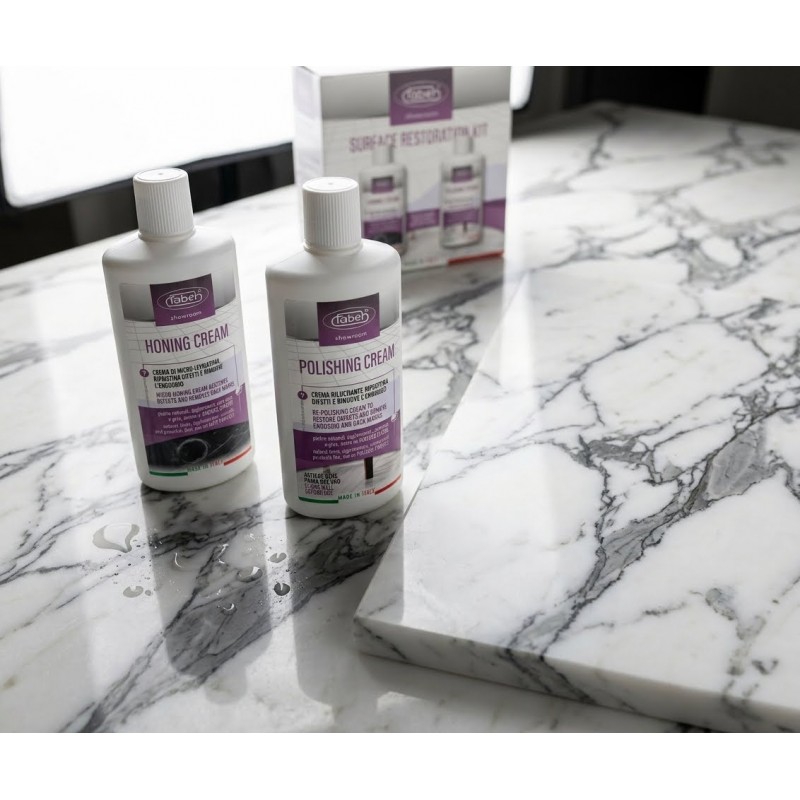
The restoration kit (Honing Cream + Polishing Cream) is an innovative, affordable solution for restoring the original luster of stone surfaces. It allows you to eliminate aesthetic imperfections on your own, without the need for costly machinery. Whether your favorite marble table has been marked by lemon juice or your glossy granite countertop has lost its sheen, this kit is a true lifesaver for your home interior.
When should you use it, and what can this system help with?
This two-component product is designed for the localized restoration of polished natural and artificial stone (including marble, travertine, limestone, acrylic, and quartz composite). This kit is ideal for addressing the following issues:
Chemical burns: dull spots caused by oxygen-based cleaning agents, wine, fruit juices, citric acid, or coffee.
Dullness: the loss of natural, mirror-like shine in high-use areas.
Fine scratches: surface damage caused by tableware, knives, or household objects.
Limescale: stubborn deposits and water spots from hard water, typically found around faucets.
Important: The system works through a process of sequential micro-sanding. The "Honing Cream" stage removes chemical damage and evens out the texture, while the "Polishing Cream" stage seals the stone's pores and brings the surface to a flawless, glossy finish.
What does the product do, and how effective is it?
The primary value of this restoration kit is its ability to restore the stone to its original, factory-fresh appearance in a matter of minutes. It is highly effective against defects that have not compromised the deep structure of the mineral. Thanks to a balanced blend of micro-abrasives and mild acids, it acts gently without creating optical distortions (or "lenses") on the surface. The result is a smooth-to-the-touch finish, vibrant stone color, and a restored protective barrier against future staining.
Comparison: The Kit vs. Professional Polishing
To determine when a manual kit is sufficient and when "heavy artillery" is required, let’s compare the two based on key criteria:
• Scope of application and depth of damage. The restoration kit is designed for delicate repair—it is ideal for addressing localized stains, dull spots, and micro-scratches. In contrast, professional polishing serves as the "heavy artillery," used when the stone features deep gouges, cracks, or significant height differences and uneven gaps between the slabs.
• Required Tools. The manual method requires minimal equipment: you need only the kit itself and a felt or cotton pad for hand application. Professional restoration, however, demands a full arsenal: a specialized polishing machine, heavy-duty planetary tools, and a set of diamond abrasive pads with grits ranging from #50 to #3000.
• Complexity Level. The kit is designed for a "do-it-yourself" (DIY) approach; the process is so straightforward that it requires no specialized skills. Machine polishing, by contrast, is highly complex, requiring the expertise and experience of a professional stone technician.
• Mess and Water. Using polishing creams is a clean, tidy process that generates very little dust or moisture. Working with diamond tools involves a complex wet process that produces a large amount of grinding slurry, necessitating thorough protection for surrounding walls and furniture.
• Time Required. Localized manual restoration takes only 15 to 30 minutes per area. A full-scale machine restoration of an entire surface takes significantly longer—ranging from several hours to several days.
• Cost. Purchasing a restoration kit is a cost-effective, budget-friendly solution. Professional services, by contrast, come with a high price per square meter, plus the cost of a service call.
Bottom line: which option should you choose?
Professional polishing using diamond tools and machinery is essential if the floor has deep scratches from footwear, or if layers of stone need to be removed to level out the joints.
However, if your goal is to remove a fresh stain—such as one left by a wine glass left out overnight—or to refresh a specific area of a countertop, a restoration kit (containing Honing Cream and Polishing Cream) will handle the task perfectly, saving you money, time, and peace of mind. It delivers professional-grade results, accessible to anyone, right at home.

4 816 грн.
RESTORATION KIT SHOWROOM = HONING CREAM + POLISHING CREAM
RESTORATION KIT SHOWROOM = HONING CREAM + POLISHING CREAMWater-based, cream poli..


